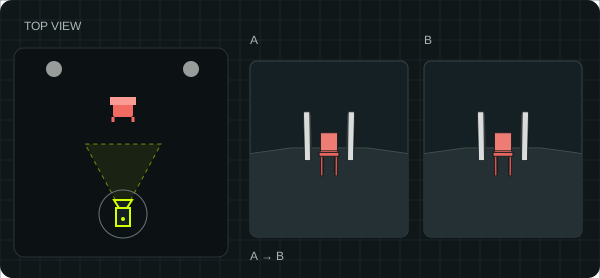
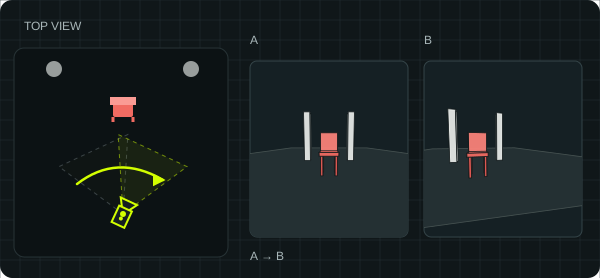
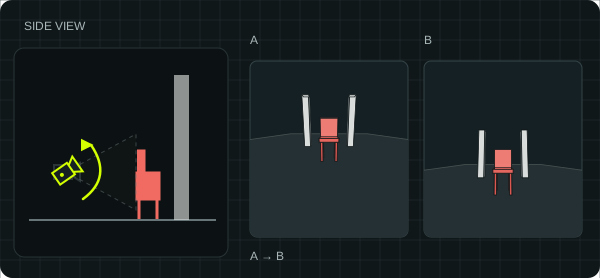
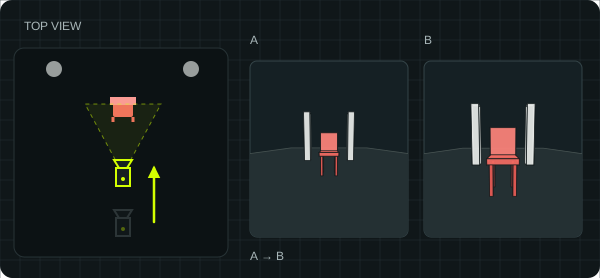
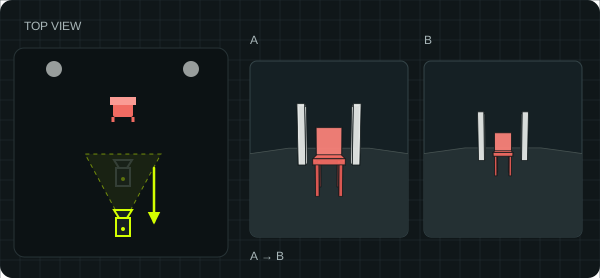
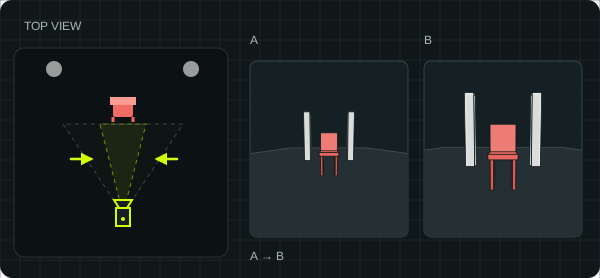
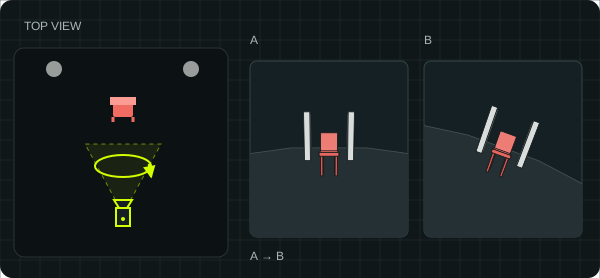
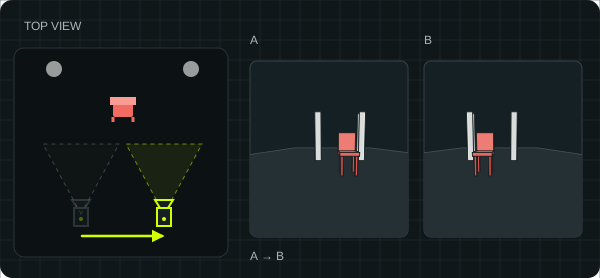
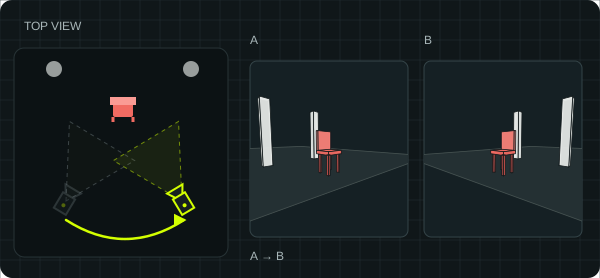
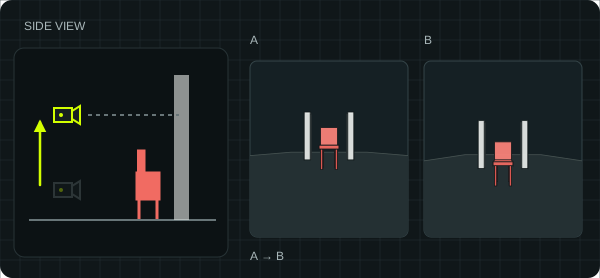
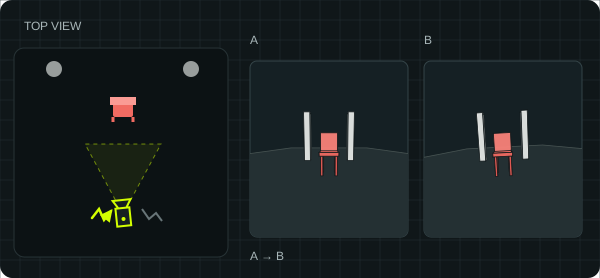
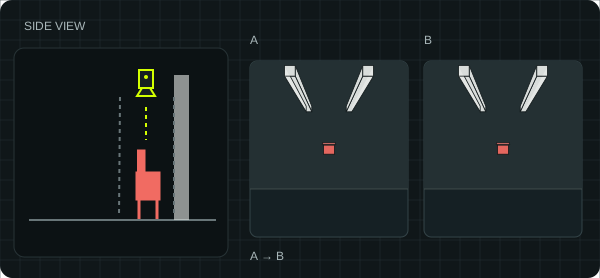
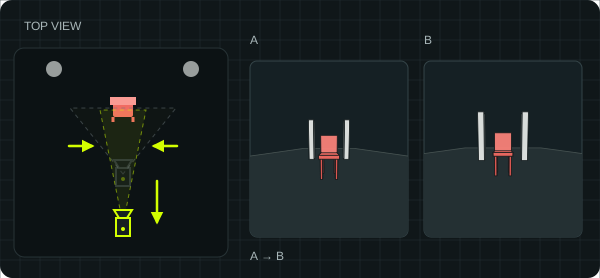
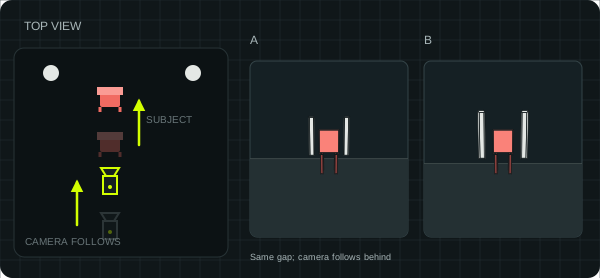
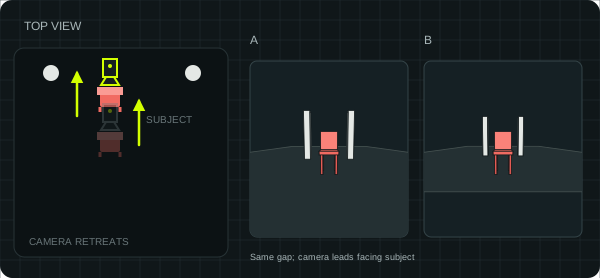
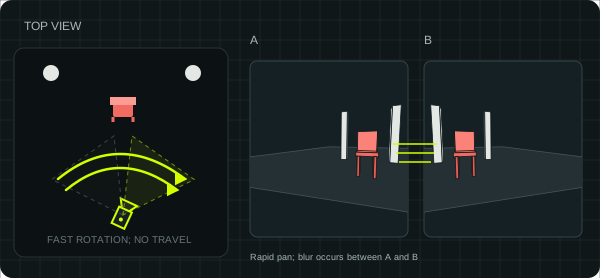
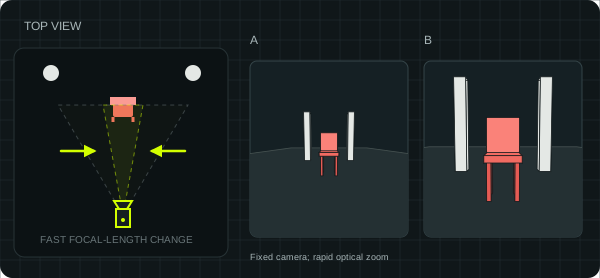
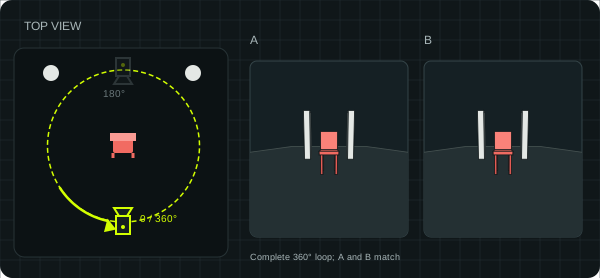
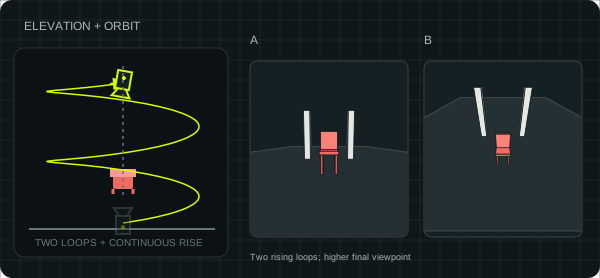
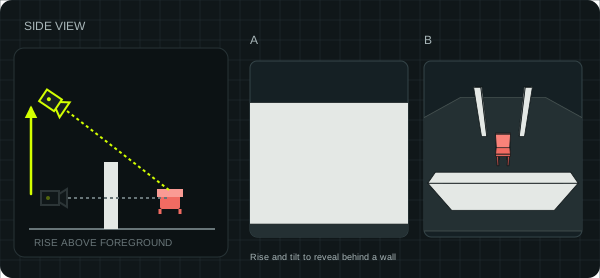
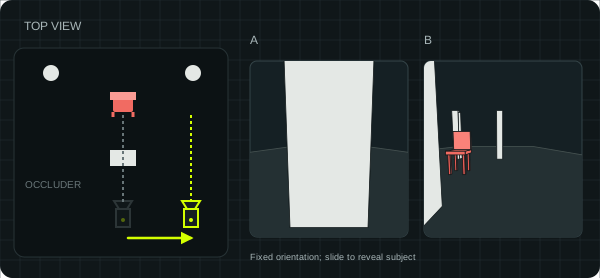
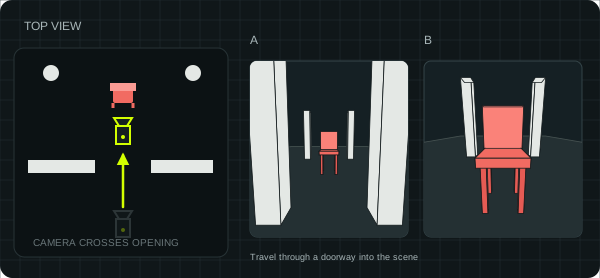
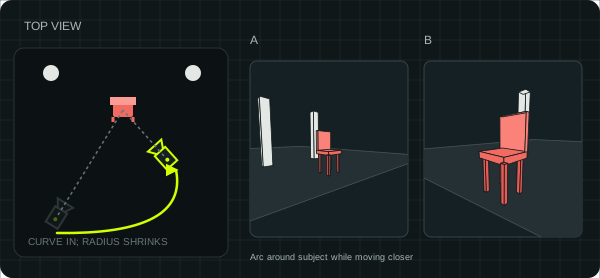
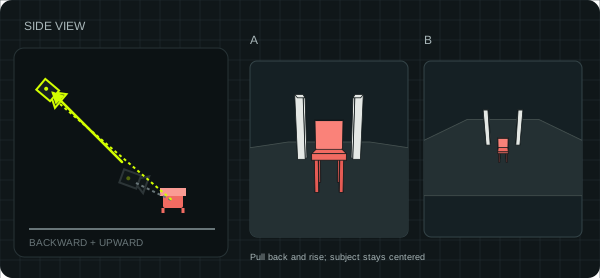
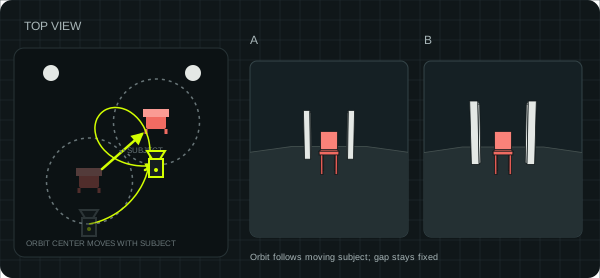
示意图为原创教学图,不是 AI 生成视频或实拍效果;左图表示相机或主体的路径或视角,右图以 A 到 B 比较取景,虚线与淡色是起始位置。入门范例写明椅子、柱子与其他场景物件全程不动,是为了先看清镜头本身怎么走;进阶提示词改用可替换栏位,请按你的主体、场景与目标构图填写,复杂路径可分步测试。镜头时长与速度请依工具设置调整。下方可搜索镜头、效果或提示词,并查看 25 则中英对照提示词、路径示意与易混淆注。本图鉴为原创教学内容,提示词尚未在任何视频生成模型中实测。示意图用来解释镜头意图,不是模型输出或效果证明;不同工具与设置可能产生不同结果。使用前请核对你所用工具的功能与限制,并先做短片测试。
原创示意图,非 AI 生成视频或实拍效果。左图表示相机/主体的路径或视角;右图 A → B 比较取景。虚线与淡色是起始位置。
相机主体
12 / 25 项镜头技巧
入门级
先掌握单一变化:位置、朝向、焦距与视角。
01
入门级
固定镜头
Static shot
相机位置、朝向与焦距都保持不变,让观众专注看清画面。这是固定的拍摄方式,没有运镜。
画面会怎样变
红椅与两根白柱的位置、大小及彼此关系保持稳定,画面安静、明确。
容易混淆的地方
只写“稳定”可能仍出现缓慢推近。想要完全固定,需同时限制位移、旋转与变焦。
可改用的提示词
英文提示词
A stationary red chair in a pale courtyard, with two stationary white columns behind it, in soft daylight. One continuous shot with an intended duration of 6 seconds, no cuts. The chair, columns, and all other scene objects remain still throughout. Use a level, wide composition showing the full chair and both columns. Lock the camera on a fixed tripod. Keep its position, orientation, and focal length unchanged throughout. No translation, pan, tilt, roll, zoom, or framing drift.
A stationary red chair in a pale courtyard, with two stationary white columns behind it, in soft daylight. One continuous shot with an intended duration of 6 seconds, no cuts. The chair, columns, and all other scene objects remain still throughout. Begin with the chair centered in a wide frame. Keep the camera position fixed and slowly pan right at a constant speed, rotating only in yaw around the vertical axis. Let the chair drift toward the left of the frame as more of the courtyard enters on the right. Keep height and focal length unchanged. No lateral translation, tilt, or zoom.
A stationary red chair in a pale courtyard, with two stationary white columns behind it, in soft daylight. One continuous shot with an intended duration of 6 seconds, no cuts. The chair, columns, and all other scene objects remain still throughout. Start with the full chair and the lower sections of the columns visible. Keep camera position and height fixed. Slowly tilt upward around the horizontal axis so the chair moves toward the bottom of the frame while the upper columns and sky come into view. Keep focal length unchanged. Do not raise or translate the camera, and do not zoom.
A stationary red chair in a pale courtyard, with two stationary white columns behind it, in soft daylight. One continuous shot with an intended duration of 6 seconds, no cuts. The chair, columns, and all other scene objects remain still throughout. Begin with a wide view of the full chair and both columns. Move the entire camera slowly forward in a straight line toward the chair. Keep camera height and orientation unchanged, with the lens aimed at the chair, a fixed focal length, and no zoom. Let the chair grow in the frame with natural perspective changes between the nearer chair and the farther columns. Do not move the chair toward the camera.
A stationary red chair in a pale courtyard, with two stationary white columns behind it, in soft daylight. One continuous shot with an intended duration of 6 seconds, no cuts. The chair, columns, and all other scene objects remain still throughout. Start in a closer composition centered on the chair, with both columns in the background. Move the entire camera smoothly backward in a straight line away from the chair. Keep orientation and focal length fixed, with no zoom. Let the chair become smaller as more of the pale courtyard is revealed, with natural perspective changes between the chair and columns.
A stationary red chair in a pale courtyard, with two stationary white columns behind it, in soft daylight. One continuous shot with an intended duration of 6 seconds, no cuts. The chair, columns, and all other scene objects remain still throughout. Begin in a wide frame with the chair centered. Keep camera position, height, and orientation fixed throughout. Smoothly increase the lens focal length to zoom in on the chair, enlarging both the chair and the background columns as the field of view narrows. Preserve their perspective relationship. No forward, backward, or sideways camera translation.
A stationary red chair in a pale courtyard, with two stationary white columns behind it, in soft daylight. One continuous shot with an intended duration of 6 seconds, no cuts. The chair, columns, and all other scene objects remain still throughout. Begin with a level frame and keep the chair centered. Fix the camera position and the direction of its optical axis. Smoothly roll the camera by 20 degrees around that optical axis, making the chair, columns, and ground tilt together in the frame. Keep focal length fixed. Do not orbit the chair, translate, pan, tilt, or zoom.
A stationary red chair in a pale courtyard, with two stationary white columns behind it, in soft daylight. One continuous shot with an intended duration of 6 seconds, no cuts. The chair, columns, and all other scene objects remain still throughout. Use a frame wide enough to include the chair and both columns. Move the entire camera slowly right along a straight horizontal path. Keep camera height, focal length, and orientation unchanged, and do not turn toward the chair. The stationary chair slides left in the frame noticeably faster than the farther columns, creating natural parallax. No pan, orbit, zoom, or movement of the chair itself.
A stationary red chair in a pale courtyard, with two stationary white columns behind it, in soft daylight. One continuous shot with an intended duration of 6 seconds, no cuts. The chair, columns, and all other scene objects remain still throughout. Start at the chair’s front-left and move smoothly along a horizontal quarter-circle to its front-right, traveling through a 90-degree arc. Keep the camera-to-chair distance, camera height, and focal length constant. Continuously turn the camera to aim at the chair, holding it roughly central and similar in scale. Let the columns and courtyard shift naturally with the changing viewpoint. The chair itself does not turn or move.
A stationary red chair in a pale courtyard, with two stationary white columns behind it, in soft daylight. One continuous shot with an intended duration of 6 seconds, no cuts. The chair, columns, and all other scene objects remain still throughout. Use a wide field of view so the chair remains visible during the rise. Move the camera smoothly straight upward from chair-seat height to adult eye level. Keep the lens level, orientation unchanged, and focal length fixed throughout. Let the chair move naturally lower in the frame, revealing more of its seat and the courtyard floor. No upward or downward tilt, forward or backward translation, or zoom.
A stationary red chair in a pale courtyard, with two stationary white columns behind it, in soft daylight. One continuous shot with an intended duration of 6 seconds, no cuts. The chair, columns, and all other scene objects remain still throughout. Shoot as if the operator is standing in place, keeping the chair roughly centered. Add only low-amplitude, slow, irregular handheld sway, with tiny lateral shifts and subtle angular variations like steady breathing. Keep focal length fixed. No deliberate travel path, walking bounce, violent jitter, whip pans, or zoom.
A stationary red chair in a pale courtyard, with two stationary white columns behind it, in soft daylight. One continuous shot with an intended duration of 6 seconds, no cuts. The chair, columns, and all other scene objects remain still throughout. Fix the camera directly above the courtyard at a height above the tops of both columns. Point the lens straight down, with the optical axis perpendicular to the ground. Frame the red chair, both white column tops, and their arrangement on the pale ground in one overhead composition, with no horizon visible. Keep camera position, orientation, and focal length fixed throughout. No descent, flight, orbit, rotation, or zoom.
A stationary red chair in a pale courtyard, with two stationary white columns behind it, in soft daylight. One continuous shot with an intended duration of 6 seconds, no cuts. The chair, columns, and all other scene objects remain still throughout. Center the chair with both columns clearly visible behind it. Move the entire camera smoothly backward in a straight line while continuously increasing focal length, zooming in to compensate for the retreat. Keep the chair at approximately the same screen height and central position throughout, while the background columns grow larger to create a pronounced background-compression effect. Do not move the chair or substitute a digital enlargement alone.
In [setting], [subject] moves forward along [route]. In one continuous shot, track behind the subject at a matching speed, keeping the gap and subject size approximately stable. Aim at the back of the subject, maintain [camera height] and a fixed focal length, and follow turns smoothly. Do not overtake, orbit to the front, or zoom. Preserve natural parallax as the surroundings pass.
In [setting], [subject] moves forward along [route]. Position the camera ahead, facing the subject’s front, and retreat as the subject advances, keeping [framing] and the relative gap approximately stable. Use one continuous shot, a fixed focal length, and [camera height], with natural background motion. The subject does not move backward. Do not switch to rear following or zoom.
In [setting], hold a clear view of [starting subject]. Keep camera position and height fixed, whip pan [left/right] with natural directional motion blur during the sweep, then decelerate and settle on [landing subject] in [framing]. One continuous shot, fixed focal length, no cut, sideways translation, or repeated back-and-forth pans.
In [setting], frame [subject] in [starting composition]. Keep camera position and orientation fixed and rapidly increase focal length, continuously tightening to [target framing/detail], then stop zooming and hold steady. No cut, forward travel, or roll. Preserve perspective from the same viewpoint; the subject does not approach the camera.
In [setting], [subject] stays in place. Move the camera [clockwise/counterclockwise] around a complete circular route, maintaining [orbit radius], [camera height], and fixed focal length. Keep aiming at the subject near [screen position]. In one continuous shot, smoothly return near the initial viewpoint. No roll, zoom, or rotation of the subject itself.
In [setting], [subject] stays in place. Orbit in [direction] while rising smoothly from [starting height] to [ending height]. Keep the horizontal orbit radius and focal length fixed, adjusting pan and tilt to hold the subject near [screen position]. Use one continuous ascending helical path, not an in-place roll. No sudden height jumps or zoom.
In [setting], start low behind [foreground obstruction], with [target subject/space] partly hidden. Raise the camera smoothly until the sightline clears the obstruction, gently adjusting tilt to reveal the target and settle into [final framing]. One continuous shot, fixed focal length. The obstruction stays solid and still; do not replace the rise with transparency, a cut, or travel through solid objects.
In [setting], place [subject] behind [foreground obstruction]. Begin partly obscured, then truck smoothly [left/right] at a fixed height so the foreground naturally clears the sightline and reveals the subject. Settle into [final framing]. Keep focal length and camera orientation fixed in one continuous shot. Subject and obstruction stay still; no cut, zoom, or disappearing obstruction.
Start in [initial space] and move smoothly forward along [clear route], through [traversable opening], into [destination space], settling into [final framing]. Use one continuous shot with [camera height] and a fixed focal length. Keep the opening and surrounding geometry stable, with natural foreground parallax. No cut, teleportation, or passage through walls or other solid objects.
In [setting], [subject] stays in place. Start at [initial side and distance], then move along a [clockwise/counterclockwise] inward-curving route toward [ending side], smoothly reducing the gap. Keep aiming at the subject near [screen position] and settle into [final framing]. One continuous shot, fixed focal length and height. No zoom, rise, descent, or rotation of the subject itself.
In [setting], begin with the stationary [subject] in [starting framing]. Retreat smoothly along a diagonal backward-and-upward route, rising from [starting height] to [ending height] while adjusting tilt toward the subject. Keep focal length fixed, allowing the subject to shrink naturally as the surroundings open up. Settle into [final framing] in one continuous shot. No zoom, orbit, or abrupt change of direction.
In [setting], [subject] keeps moving along [route]. Follow its translation while orbiting smoothly [direction] from its [initial side] to its [ending side]. The orbit center travels with the subject. Maintain approximately constant relative distance, camera height, and focal length, continually aiming at the subject. One continuous shot. The subject does not stop or spin; do not circle a fixed ground point, zoom, or cross obstacles.